The Reality Check: LLM-Generated Code vs. Human Engineers


LLMs and “AI-assisted coding” are rapidly reshaping how we develop software. Auto-complete, boilerplate generation, refactoring — many teams already rely on these tools daily. But does that mean we can trust LLMs to handle complex, real-world tasks the way experienced engineers do?
Researchers behind the paper picked a very ambitious test to answer this: they pitted LLM-generated agents against human-coded agents in a competitive logistics simulation involving auctions, route planning, and capacity constraints — a benchmark called the Auction, Pickup, and Delivery Problem (APDP).
In simple terms: these weren’t toy problems. This was strategic planning + optimisation + competition — the kind of complexity many software teams deal with in real systems (think supply-chain, resource scheduling, fleet routing, dynamic load balancing, etc.).
What they tested
-
40 different LLM-coded agents (various models, prompting strategies) vs. 17 human-coded agents (graduate-level CS students + baseline agents).
-
Dozens of full rounds (all-play-all tournaments), covering various network topologies and randomly generated tasks.
-
Scoring by profitability: optimal bidding, efficient routing, capacity constraints, and strategic decision-making under uncertainty.
The results
-
Human-coded agents dominated: the top 5 places were always taken by humans.
-
Most LLM-generated agents (33 out of 40) performed worse than even simple baseline strategies.
-
Even when given the best human solution and asked to “improve” it, the best LLM degraded performance — finishing 10th.
Conclusion: While LLMs are impressive at generating syntactically correct code (the “auto-complete” level), they still fall short when it comes to reasoning-intensive, strategy-heavy, multi-agent problems.
What This Means for Dev Teams & Cloud-Native Builders
As engineers working in cloud-native, distributed, or complex domains, these findings carry important implications:
-
Don’t confuse “works in isolation” with “works under complexity.” LLMs may help with scaffolding, boilerplate, or simple functions — but real-world services often include concurrency, distributed coordination, optimisation, and edge cases.
-
AI-assisted coding ≠ architecture or logic thinking. Tools help you write faster — but they don’t (yet) replace thoughtful system design, algorithmic reasoning, or strategic decision-making.
-
Testing and benchmarks matter. Many LLM-evaluation benchmarks rely on unit-test pass rates or small problem sets. But as this study shows, performance on “toy tasks” doesn’t guarantee viability in production-like scenarios.
-
Human oversight remains critical. Generated code must be carefully reviewed, profiled, and tested under real conditions (load, edge cases, failure scenarios) — especially in safety-critical or high-stakes domains.
How You Can Use This Insight (if you’re building cloud-native or complex systems)
Use Case
Scaffolding & Boilerplate
Complex Logic / Business Rules
Optimisation & Scheduling Services
Critical Production Systems (resilience, security, compliance)
Team Productivity & Onboarding
What to Do
Use LLMs (or AI tools) for routine setup: service skeletons, configs, simple refactors. Great time-saver.
Rely on human developers for core logic, orchestration, strategy — treat generated code as draft, not final.
Write and maintain yourself. Use LLMs only for helper code (wrapper, configs), not core algorithms.
Don’t trust generated code blindly. Combine with rigorous review, automated tests, and real-world stress tests.
Use LLMs to reduce friction for new team members — but pair with mentorship, peer review, and shared knowledge.
In short: treat LLMs as powerful assistants, but not as autonomous developers.
Limitations & What the Research Doesn’t Show
It’s worth being transparent about the boundaries of this research:
-
The benchmark (APDP) is one domain — logistics optimisation under auctions + routing. Other domains (web development, CRUD, data pipelines, etc.) may yield different results.
-
LLM capabilities evolve quickly. Models used in the study might already be outdated; newer ones might perform differently.
-
Human-coded agents had the advantage of understanding the domain deeply — a condition not always available.
So, while the findings are relevant, they are not a final verdict on LLM utility. They highlight where LLMs struggle today — and where humans still lead.
Our Take at ZEN
At ZEN, we believe in combining human expertise + smart tools + cloud infrastructure to deliver robust, scalable, and maintainable systems.
This research reminds us that:
-
AI tools are just that — tools, not replacements.
-
For mission-critical systems, architecture, reasoning, and human judgment remain irreplaceable.
-
The real value of LLMs lies in augmenting developer productivity, not replacing understanding.
If you’re building complex cloud-native systems, distributed services, or optimisation-heavy backends — design with caution, test with rigour, and use AI as an assistant, not an autopilot.
Source: Danassis, P., & Goel, N. (2025). Can Vibe Coding Beat Graduate CS Students? An LLM vs. Human Coding Tournament on Market-driven Strategic Planning. arXiv preprint arXiv:2511.20613.

We're confident we can supercharge your software operation
Our products and services will delight you.
Read more:
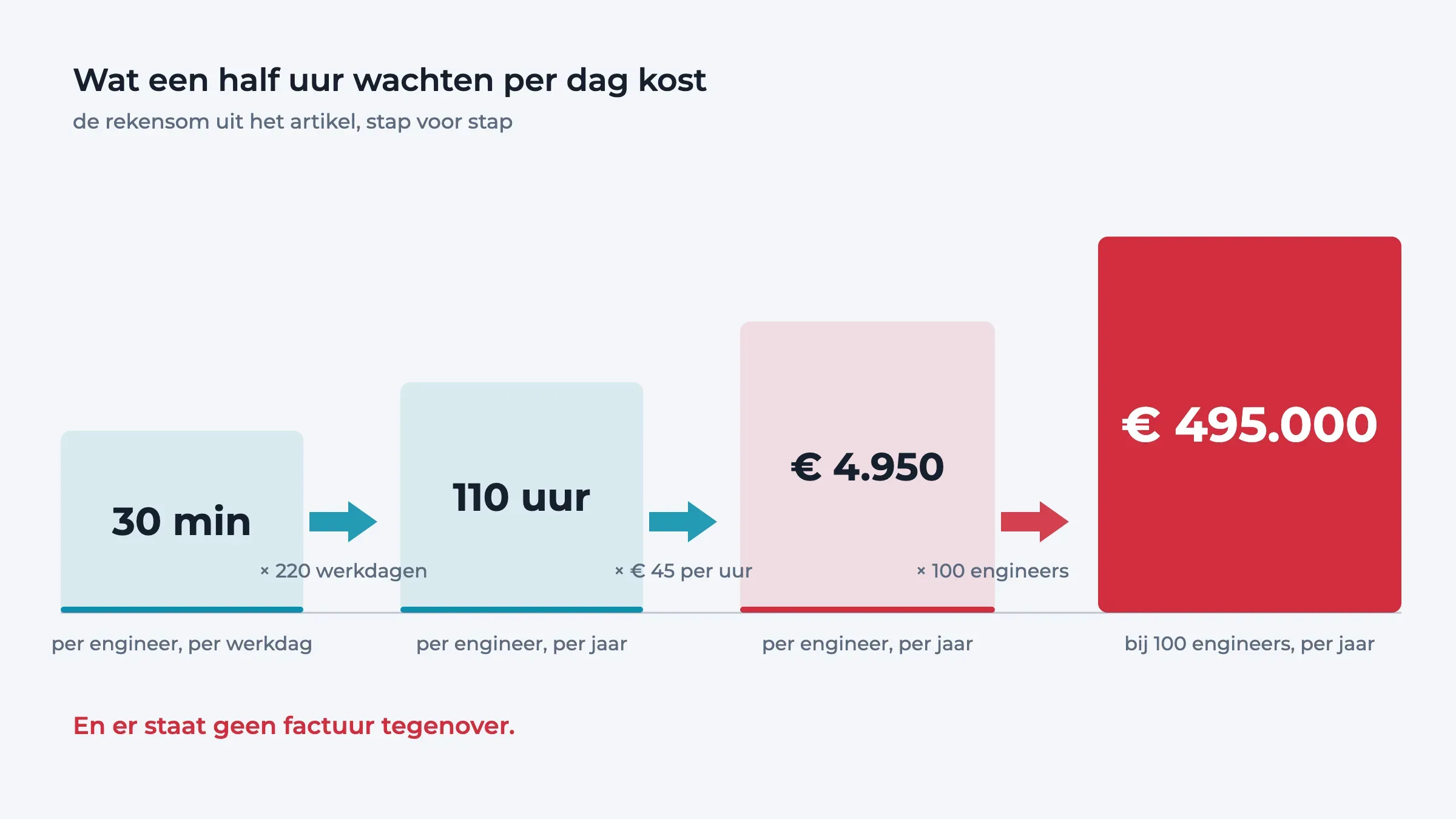
What Thirty Minutes of Waiting per Engineer per Day Really Costs
Half an hour a day. It sounds like nothing. But work it through and it is €5,000 per engineer per year, or half a millio...
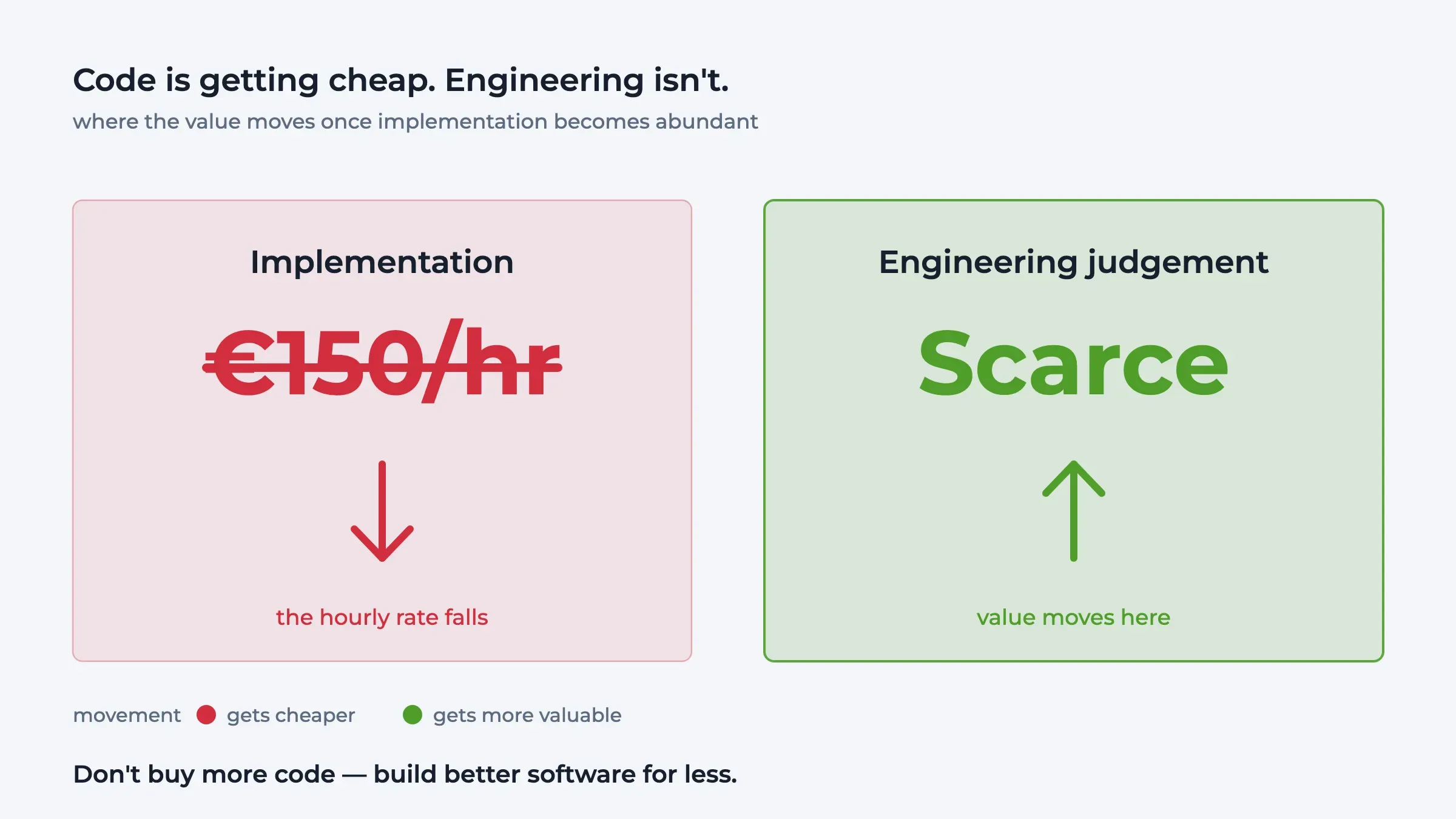
Code is getting cheap. Engineering isn't.
A developer with twenty years' experience stopped coding with AI — not because it failed, but because it worked too well...
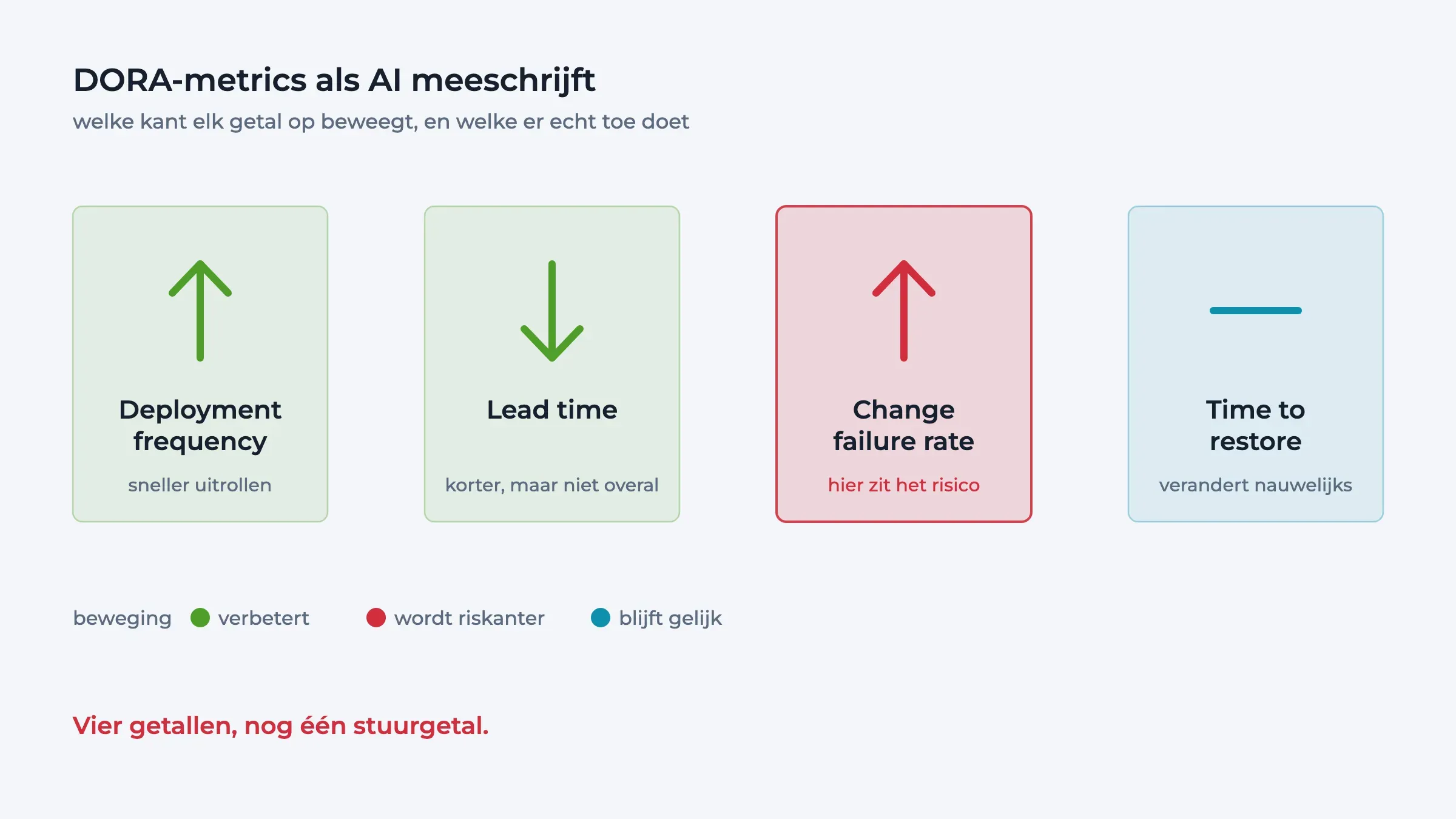
Reading DORA Metrics When AI Writes Half Your Commits
Your DORA dashboard still shows the same four numbers. They no longer mean the same thing. Once a serious share of your ...

AI-Assisted Development under GDPR, NIS2 and DORA
The moment you attach a coding agent to your codebase, you touch three regulatory regimes at once. Not because AI is sep...

CI/CD Pipelines Shouldn’t Be a Full-Time Job
If you’ve ever felt like your CI/CD pipeline is working against you rather than for you, you’re not alone. The promise o...

Reviewing AI-Generated Infrastructure Code: What to Actually Look For
Application code that is wrong usually breaks. Infrastructure code that is wrong works — and that is exactly the problem...