If AI Replaces Junior Roles, Where Do Senior Developers Come From?

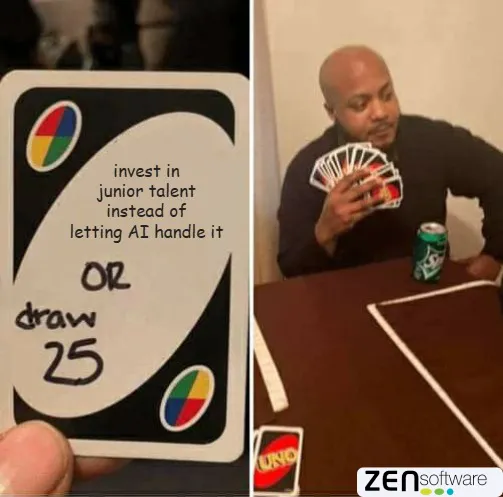
There’s a quiet contradiction in how people talk about AI in software development.
On one side, there’s excitement about replacing junior work. Boilerplate, simple features, small bug fixes—things that used to be entry points are now increasingly handled by AI. The argument is that this frees up time, reduces costs, and lets teams move faster. That part is hard to argue with.
But it leaves an uncomfortable question hanging in the background: if fewer people start at the junior level, where do senior developers come from later? Because senior engineers don’t appear fully formed. They’re shaped over time, often by doing exactly the kind of work that is now being automated away.
The Work That Didn’t Seem Important
A lot of early-career work doesn’t look impressive from the outside. Fixing small bugs, writing repetitive code, tracing through unfamiliar systems, and sitting with problems longer than you’d like because you don’t yet know the shortcuts.
It’s slow, and sometimes frustrating. But it builds something that’s hard to shortcut: context.
You start to recognize patterns. You see how small decisions affect larger systems. You get a feel for where things tend to break and why. None of that comes from reading architecture diagrams alone. If those experiences disappear—or get compressed into something lighter—it’s not obvious what replaces them.
Learning by Doing vs. Learning by Reviewing
There’s a subtle shift happening in how developers interact with code. Instead of writing everything from scratch, more of the work involves reviewing, adjusting, and guiding what AI produces. That’s a different mode of thinking. You’re evaluating output rather than constructing it step by step.
For experienced developers, that can be efficient. They already have a mental model to compare against. For someone earlier in their career, it’s less clear. Reviewing code assumes you know what “good” looks like. It assumes you can spot edge cases, understand trade-offs, and recognize when something feels off. Those are exactly the skills juniors are still building.
If the primary task becomes “check what the AI wrote,” there’s a risk that people learn to accept or tweak solutions without fully understanding them.
Fewer Ramps Into the Industry
There’s also a pipeline problem that doesn’t get talked about much. Junior roles have always been more than just cheap labor. They’ve been entry points. Places where people get their first exposure to real systems, real constraints, and real consequences. If those roles shrink significantly, the path into the industry becomes narrower.
Companies might still hire fewer, more “AI-augmented” juniors. Or they might expect new hires to arrive with a higher baseline of experience, which shifts the burden elsewhere—onto personal projects, unpaid work, or already saturated training programs. Either way, the system becomes less forgiving.
Experience Isn’t Just Time
There’s a temptation to think this will sort itself out. That people will just “level up” differently, or that AI will somehow accelerate the path to seniority.
Maybe, to some extent. But experience isn’t only about exposure to solutions. It’s about encountering problems in messy, unpredictable contexts, and making decisions with incomplete information and dealing with the consequences. That kind of learning doesn’t compress easily.
You can speed up parts of it. You can remove some repetition. But it’s not clear that you can skip it entirely and end up in the same place.
What Might Change
It’s possible that the role of junior developers doesn’t disappear so much as it changes shape. Instead of focusing on implementation, early-career developers might spend more time understanding systems, validating AI output, and working closer to product and design. The bar for entry might shift from “can you write this” to “can you reason about this. That sounds promising in theory.
In practice, it depends heavily on how teams structure that work. Without deliberate effort, it’s easy for juniors to end up in a passive role—watching systems run, reviewing changes, but not owning enough of the problem to build real depth.
The Responsibility Doesn’t Go Away
If the industry does rely more on AI and less on traditional junior work, something else has to take its place.
Mentorship becomes more important, not less. Systems need to be explained, not just used. Decisions need to be visible, not hidden inside generated code. Teams have to make space for learning, even when speed is the default pressure.
That requires intent. Left on its own, the system will likely optimize for short-term efficiency. Fewer juniors, more output, faster delivery. The long-term effects—on skill development, on system quality, on the availability of experienced engineers—take longer to show up.
A Question Worth Taking Seriously
There isn’t a clean answer yet. AI is already changing how software is built, and some of those changes are genuinely useful. Ignoring them doesn’t make sense. At the same time, the industry still depends on people who understand systems deeply, who can make decisions in ambiguous situations, and who can guide others. Those people don’t come from nowhere. If the path that used to produce them starts to erode, it’s worth asking what replaces it—before the gap becomes obvious.
Because by the time you notice you don’t have enough senior engineers, it’s already too late to train them.

We're confident we can supercharge your software operation
Our products and services will delight you.
Read more:
If AI Replaces Junior Roles, Where Do Senior Developers Come From?
There’s a quiet contradiction in how people talk about AI in software development. On one side, there’s excitement about...

Will Software Security Improve with AI Coding Agents Like Claude Mythos — Or Get Worse?
Every new wave of tooling in software development comes with the same split reaction. Some people see leverage. Others s...
Bug Fixing in the Age of AI: How to Use Coding Agents Without Turning Your Codebase Into Spaghetti
Bug fixing has changed. Not because bugs are different. They’re still null references, race conditions, broken assumpti...
AI Fatigue in Development: Why Constant AI Assistance Can Wear You Down
There’s a familiar pattern among developers who have spent any time with AI-assisted tools: initial curiosity, followed ...
The Reality Check: LLM-Generated Code vs. Human Engineers
LLMs and “AI-assisted coding” are rapidly reshaping how we develop software. Auto-complete, boilerplate generation, refa...

The AI Revolution: How Generative AI is Making SEO practices Obsolete!
Artificial Intelligence (AI) and Generative AI are leading a revolution that will obsolete traditional SEO practices lik...